Unit 1 · Foundation of DSA
Abstract Data Type (ADT)
Understand Abstract Data Types in DSA, including definition, behavior, examples, operations, and how ADTs differ from data structures.
Introduction
An Abstract Data Type (ADT) is a high-level description of a data type. It defines a set of values and a set of operations that can be performed on those values, without specifying how it will be implemented.
Think of a car. As a driver, you know the operations: steer, accelerate, brake. You don't need to know the internal mechanics of the engine or the braking system to drive it. The car's dashboard and controls are its "interface." An ADT is like that interface for data—it tells you *what* you can do, not *how* it's done.
This separation is useful because a programmer can first understand the behavior of a structure and later choose the best implementation for speed, memory, and simplicity.
ADT (The "What"): A list can store items, add items, and remove items.
        ↓
Data Structure (The "How"): Implement the list using an Array or a Linked List.
        ↓
Program (The "Usage"): Use the list's add/remove functions without caring if it's an array or linked list inside.
Why ADT is Important
Clear Thinking
ADT separates behavior from implementation, making concepts easier to understand.
Flexible Design
The same ADT can be implemented using arrays, linked lists, or other structures.
Reusable Logic
Code can depend on operations instead of low-level storage details.
Interview Foundation
Stack, Queue, List, Map, and Set are often discussed first as ADTs.
Table of Contents
Definition of Abstract Data Type
An Abstract Data Type (ADT) is a mathematical model for data types. An ADT is defined by its behavior (semantics) from the point of view of a user of the data. Specifically, it defines:
- A collection of data values.
- A set of operations on that data.
The word "abstract" is key here. It means we are hiding the internal details of how the operations work and how the data is stored in memory. This is a form of "data abstraction" or "information hiding," a fundamental principle in software engineering.
Simple definition: ADT tells what operations are possible; implementation tells how those operations work.
ADT vs. Data Structure
A Data Structure is the actual physical or logical arrangement used in memory. An ADT is the rulebook that describes behavior.
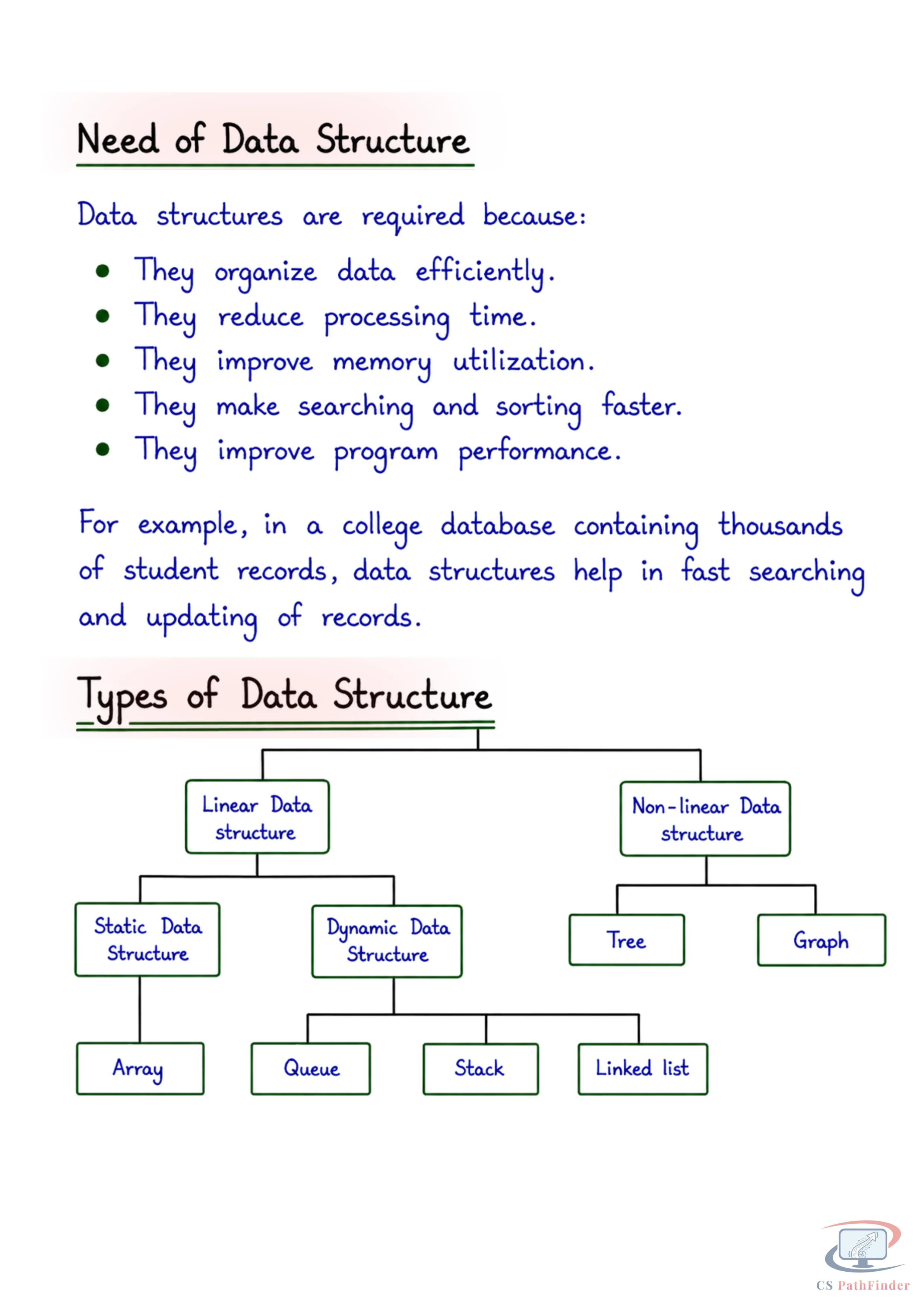
For example, Stack is an ADT. Its rules are "Last-In, First-Out" (LIFO) and it supports operations like `push`, `pop`, and `peek`. This ADT can be implemented using different data structures:
- Using an Array data structure.
- Using a Linked List data structure.
Both implementations will provide the same `push` and `pop` functionality, but their performance characteristics (speed, memory usage) might differ. The ADT is the blueprint; the data structure is the concrete implementation.
- ADT: Stack with push, pop, peek.
- Implementation: Stack using array or linked list.
- User view: Use push and pop without caring about memory details.
Common Examples of ADT
Many DSA topics are first understood as ADTs because their behavior matters before their implementation.
List ADT
Stores an ordered sequence of elements. Operations include `add(item)`, `remove(index)`, `get(index)`, `size()`.
Stack ADT
Stores elements in a Last-In, First-Out (LIFO) order. Operations include `push(item)`, `pop()`, `peek()`, `isEmpty()`.
Queue ADT
Stores elements in a First-In, First-Out (FIFO) order. Operations include `enqueue(item)`, `dequeue()`, `front()`, `isEmpty()`.
Map ADT (or Dictionary)
Stores a collection of key-value pairs, where each key is unique. Operations include `put(key, value)`, `get(key)`, `remove(key)`.
Benefits of ADT
ADT helps programmers build modular programs. Once the operations are clearly defined, the internal implementation can be improved later without changing the code that uses it.
- Improves readability and program design.
- Hides unnecessary internal details.
- Allows multiple implementations for the same behavior.
- Makes debugging and testing easier.
ADT and Possible Implementations
| ADT | Main Operations | Possible Implementation |
|---|---|---|
| Stack | push, pop, peek | Array or Linked List |
| Queue | enqueue, dequeue, front | Array, Circular Array, or Linked List |
| List | insert, delete, search, traverse | Array or Linked List |
| Map | put, get, remove | Hash Table or Tree |
C Program Example
This program demonstrates the Stack ADT. Notice how the `main` function uses `push` and `pop` without needing to know that an array is being used internally. We could replace the array with a linked list, and the `main` function would not need to change.
#include <stdio.h>
#define MAX 5

// The data structure implementing the Stack ADT
int stack[MAX], top = -1;

// Operation to add an item
void push(int value) {
    if (top == MAX - 1) {
        printf("Stack Overflow\n");
        return;
    }
    stack[++top] = value;
}

// Operation to remove an item
int pop() {
    if (top == -1) {
        printf("Stack Underflow\n");
        return -1; // Return an error value
    }
    return stack[top--];
}

int main() {
    push(10);
    push(20);
    printf("Popped: %d\n", pop()); // Popped: 20
    printf("Popped: %d\n", pop()); // Popped: 10
    return 0;
}
Output:
Popped: 20
Popped: 10
Key Points
- ADT defines behavior and operations, not implementation.
- Stack, Queue, List, Set, and Map are common ADTs.
- The same ADT can have multiple implementations.
- ADT improves modularity, abstraction, and clean program design.
Interview Tip
When explaining an ADT, first mention its allowed operations and rules, then mention possible implementations.
Common Beginner Mistakes
- Calling every ADT a data structure without explaining the difference.
- Jumping to implementation before understanding behavior.
- Forgetting that one ADT can be implemented in multiple ways.
Quick Revision
- ADT = logical behavior.
- Data Structure = actual organization in memory.
- Stack ADT can be implemented using arrays or linked lists.
- Abstraction helps hide unnecessary details.
Summary
An Abstract Data Type is a conceptual blueprint that defines a data type's behavior through a set of operations, hiding the underlying implementation. This principle of abstraction allows programmers to write cleaner, more modular, and more flexible code.
By separating the "what" (the ADT's interface) from the "how" (the data structure's implementation), we can design complex systems more effectively and switch out implementations as needed without breaking the rest of the program.