Unit 1 · Foundation of DSA
What is Data Structure?
Learn what a Data Structure is, why it is important, its characteristics, and how it helps computers organize data efficiently.
Introduction
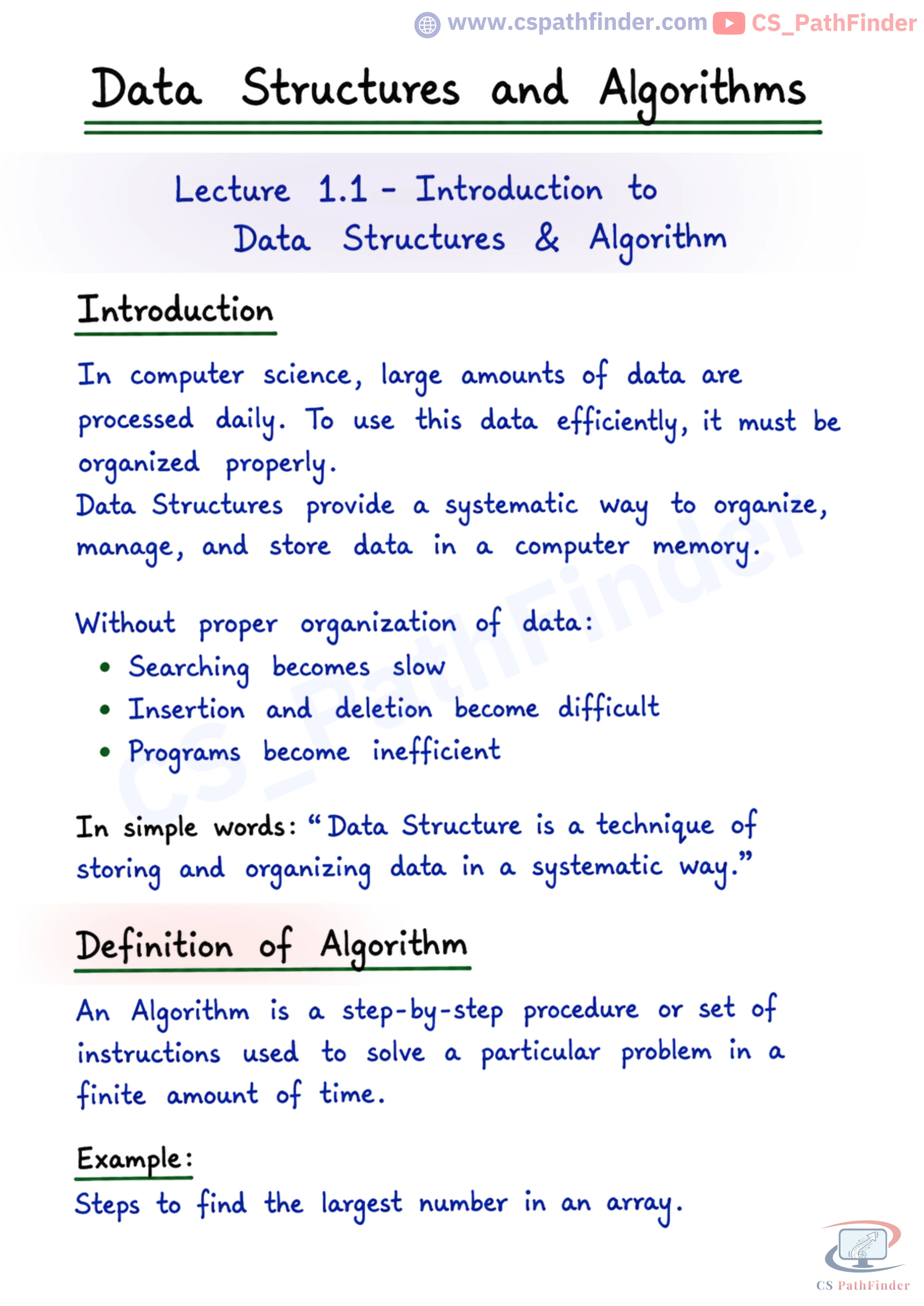
Every computer program works with data. Whether you're using Instagram, WhatsApp, YouTube, or an online banking application, thousands of pieces of data are being stored, updated, searched, and processed every second.
But imagine if all this data were stored randomly without any organization. Finding a single record would become slow and difficult, making the application inefficient.
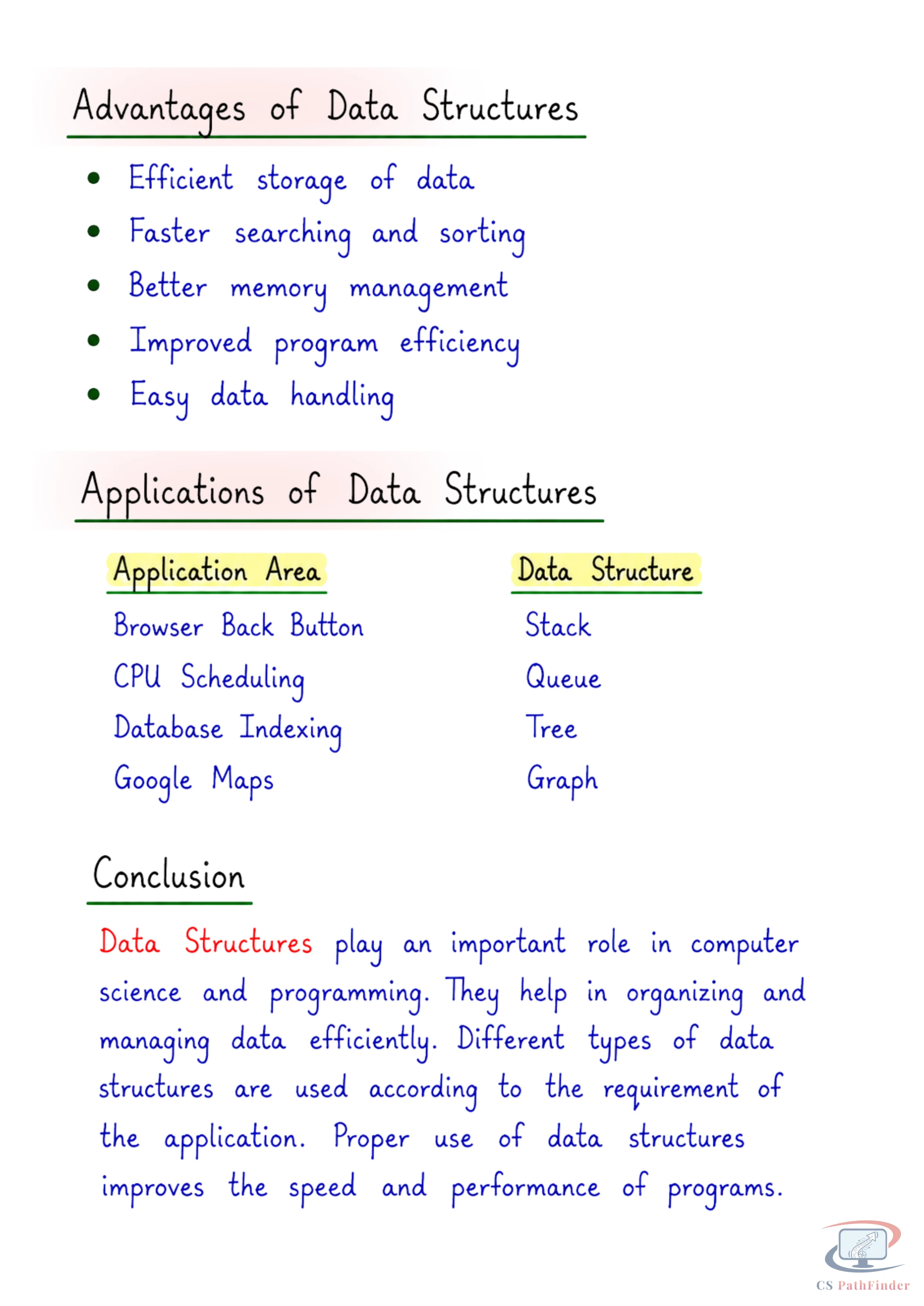
This is where Data Structures come into the picture. A Data Structure provides a systematic way of organizing and storing data so that it can be accessed, modified, and processed efficiently.
In simple words, a Data Structure is like an organized container that keeps data arranged in a meaningful way. Different problems require different methods of storing data, which is why there are many different types of Data Structures.
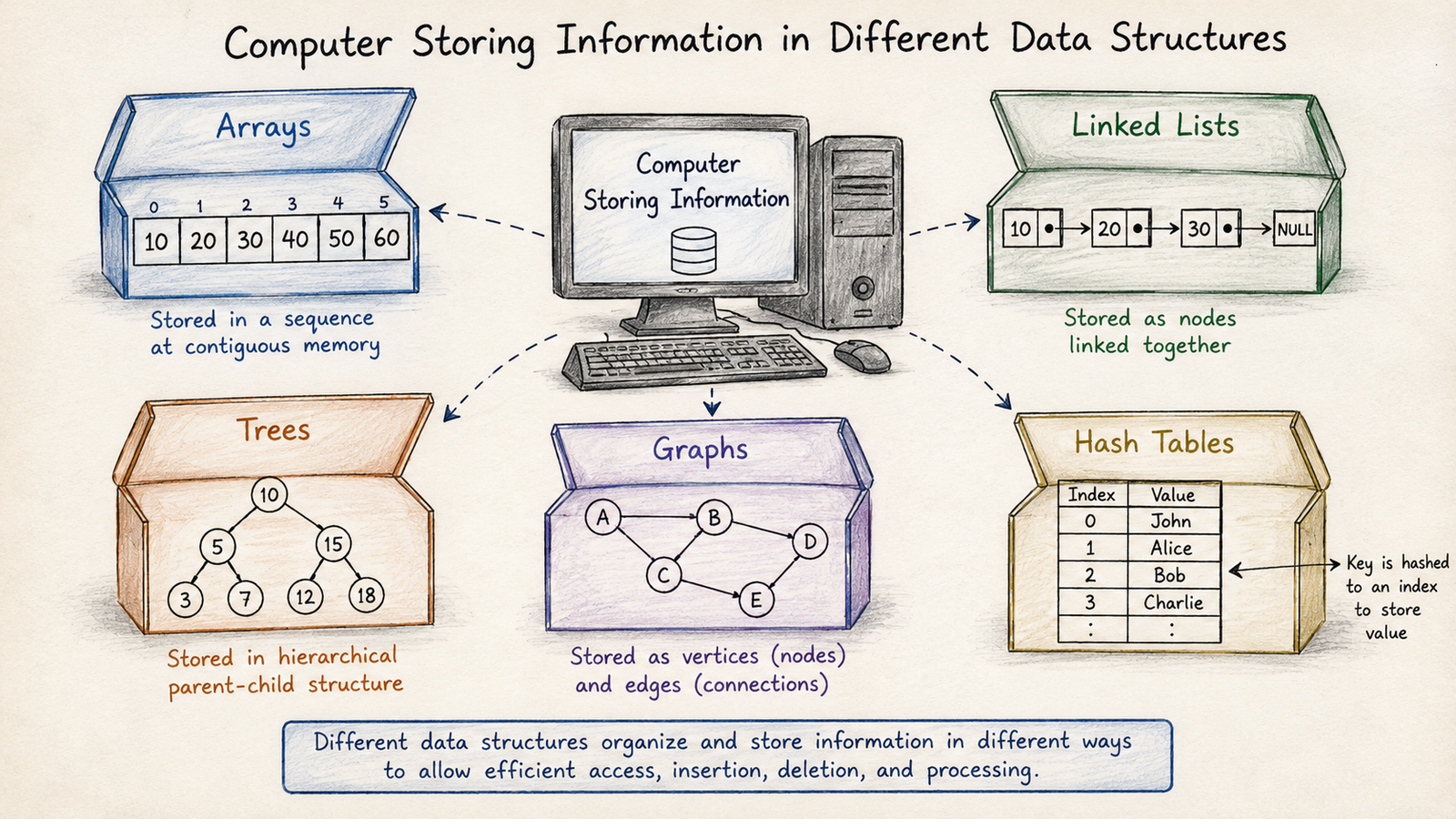
Table of Contents
What is a Data Structure?
A Data Structure is a method of organizing, storing, and managing data so that operations such as searching, inserting, deleting, updating, and sorting can be performed efficiently.
It defines how data is arranged inside the computer's memory and how different pieces of data are connected with one another.
Choosing the correct Data Structure directly affects the speed and performance of a program. The same problem can have multiple solutions, but selecting the right Data Structure often makes one solution much faster than another.
Definition: A Data Structure is a specialized way of organizing data in a computer so that it can be used efficiently.
Why Do We Need Data Structures?
Modern applications deal with huge amounts of information. Without proper organization, processing millions of records would become extremely slow.
Faster Searching
Data Structures help locate information quickly instead of checking every record one by one.
Better Memory Usage
Efficient organization reduces unnecessary memory consumption.
Improved Performance
Applications become faster because operations require less time.
Scalability
Efficient Data Structures allow applications to handle millions of users smoothly.
Easier Problem Solving
Many algorithms are built around specific Data Structures.
Real World Applications
Every modern software system uses Data Structures internally.
Characteristics of a Good Data Structure
A good Data Structure should organize data efficiently while minimizing memory usage and processing time.
1. Efficient Storage
Data should occupy minimum memory without unnecessary duplication.
2. Fast Access
Users should be able to retrieve information quickly.
3. Easy Modification
Inserting, deleting, or updating data should be efficient.
4. Scalability
It should perform efficiently even when the amount of data grows significantly.
Types of Data Structures
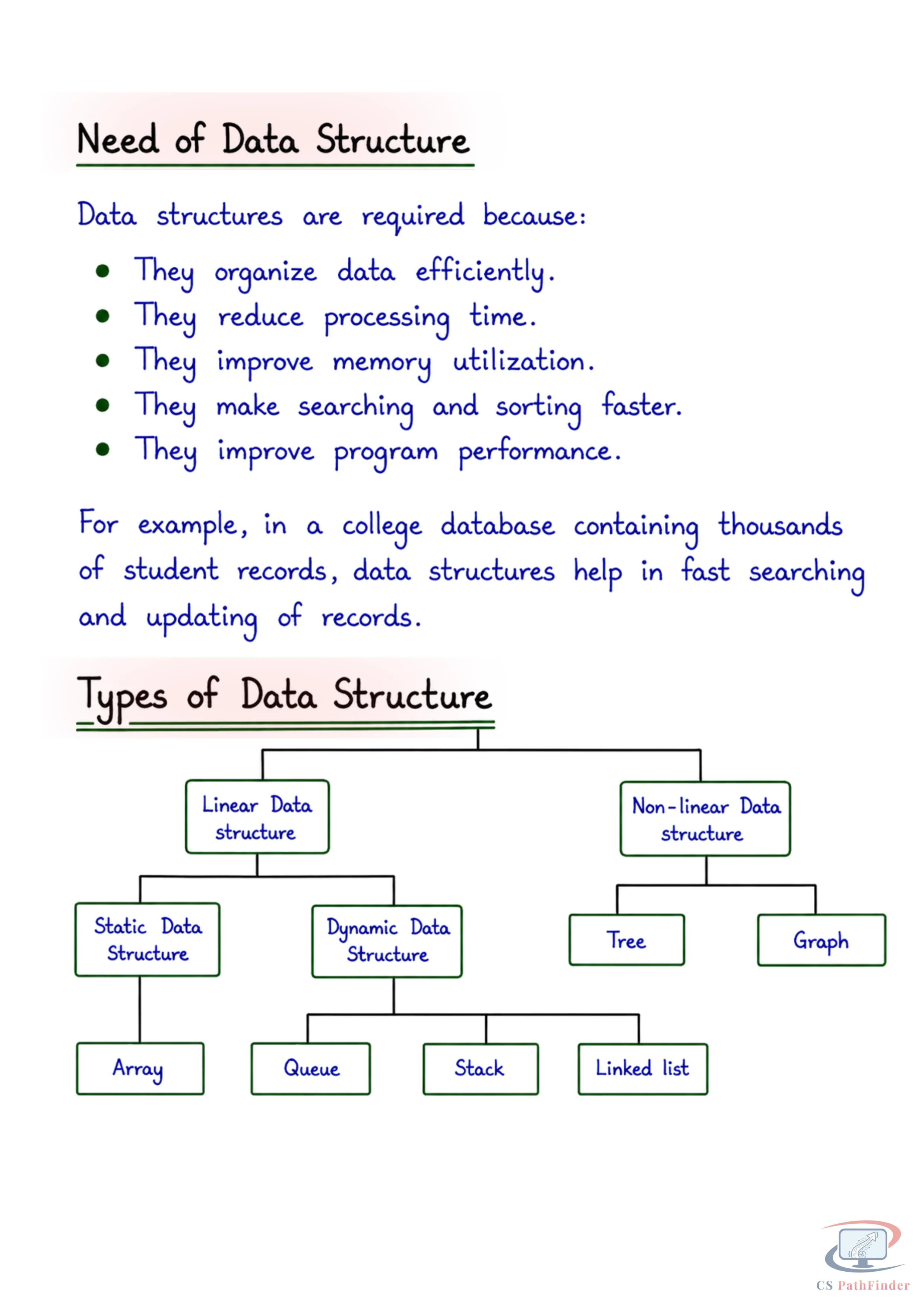
Data Structures are broadly classified into two main categories based on how data is organized.
Linear Data Structure
In a Linear Data Structure, data elements are arranged sequentially. Each element is connected to its previous and next element.
- Array
- Linked List
- Stack
- Queue
Non-Linear Data Structure
In a Non-Linear Data Structure, elements are connected in hierarchical or network form instead of a single sequence.
- Tree
- Graph
- Heap
- Trie
Linear vs Non-Linear Data Structures
| Feature | Linear | Non-Linear |
|---|---|---|
| Arrangement | Sequential | Hierarchical / Network |
| Traversal | Single Path | Multiple Paths |
| Complexity | Simple | Comparatively Complex |
| Examples | Array, Stack, Queue | Tree, Graph |
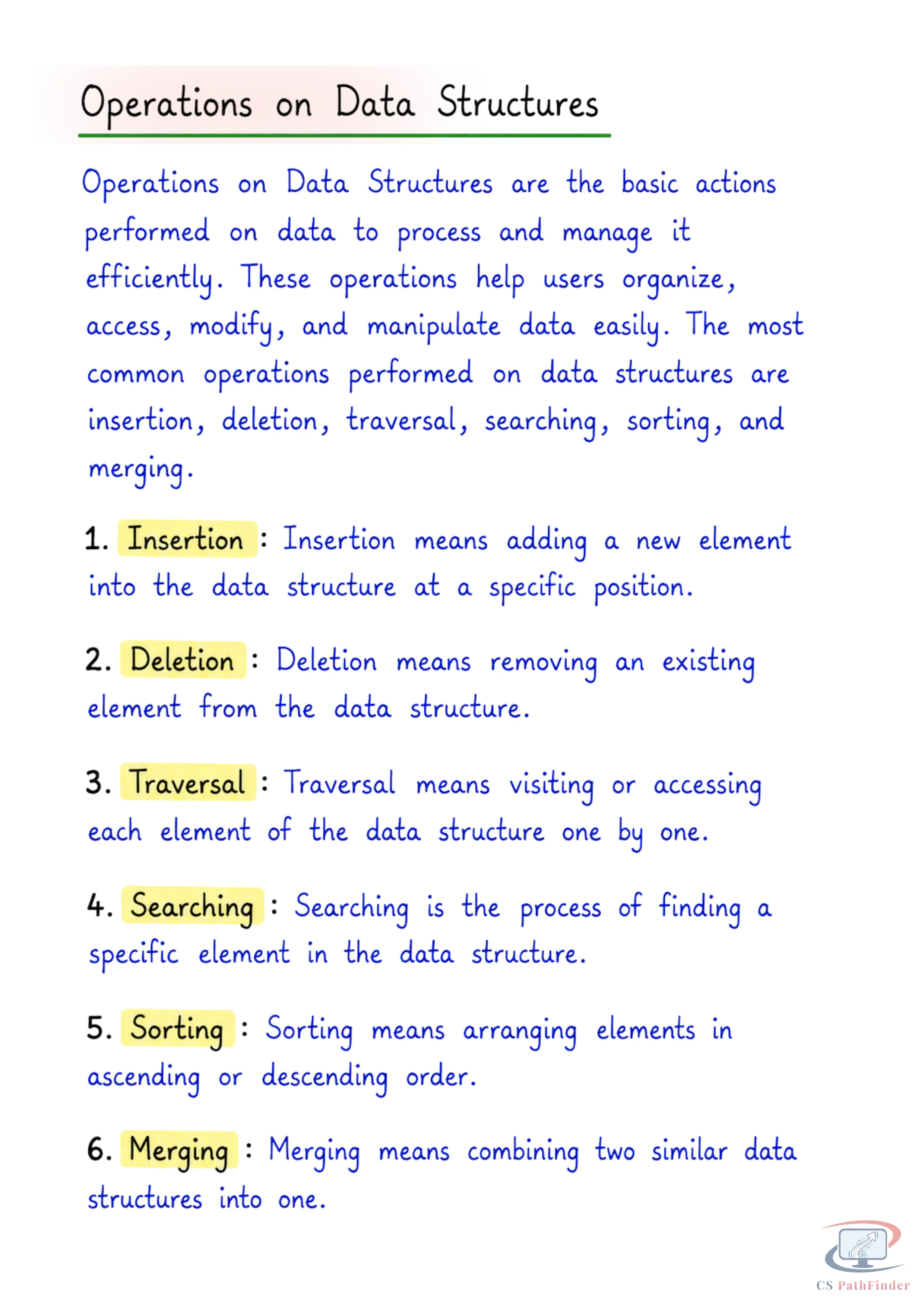
Basic Operations on Data Structures
Almost every Data Structure supports a set of common operations.
Insertion
Add new data into the Data Structure.
Deletion
Remove existing data from the Data Structure.
Searching
Find a specific element efficiently.
Updating
Modify an existing element.
Sorting
Arrange data in ascending or descending order.
Traversal
Visit every element one by one.
Real Life Example
Imagine a library containing thousands of books.
If all books are placed randomly on the floor, finding a particular book would take a lot of time.
Instead, books are organized into shelves according to subjects, authors, and categories. This organized arrangement is exactly what a Data Structure does for a computer.
Books (Data)
      ↓
Bookshelf (Data Structure)
      ↓
Search Method (Algorithm)
      ↓
Required Book
C Program Example
The following program stores marks of five students inside an array, which itself is one of the simplest Data Structures.
#include <stdio.h>

int main() {

    int marks[5] = {78, 85, 91, 69, 88};

    for(int i = 0; i < 5; i++){

        printf("%d ", marks[i]);

    }

    return 0;

}
Output:
78 85 91 69 88
Key Points
- Data Structure organizes data efficiently.
- It improves searching, insertion, deletion, and updating speed.
- Different problems require different Data Structures.
- Choosing the right Data Structure improves software performance.
- Arrays, Linked Lists, Trees, Graphs, Stacks, and Queues are common Data Structures.
Interview Tip
Interviewers often ask why one Data Structure is better than another. Always explain using time complexity and memory usage instead of only giving definitions.
Common Beginner Mistakes
- Thinking every problem can be solved efficiently using Arrays.
- Ignoring memory consumption while selecting a Data Structure.
- Memorizing definitions instead of understanding applications.
- Learning algorithms without understanding the underlying Data Structure.
Quick Revision
| Concept | Meaning |
|---|---|
| Data Structure | Method of organizing data. |
| Linear | Sequential arrangement of data. |
| Non-Linear | Hierarchical or network arrangement. |
| Operations | Insertion, Deletion, Searching, Traversal, Sorting. |
Summary
A Data Structure is a systematic way of organizing and storing data to perform operations efficiently. Different Data Structures are designed for different types of problems. Learning when and where to use the right Data Structure is one of the most important skills for every programmer and software engineer.