Unit 1 · Introduction to Python
Introduction to Python
Meet the language that powers everything from web apps to AI models — and discover why it's the perfect first language for beginners.
Introduction
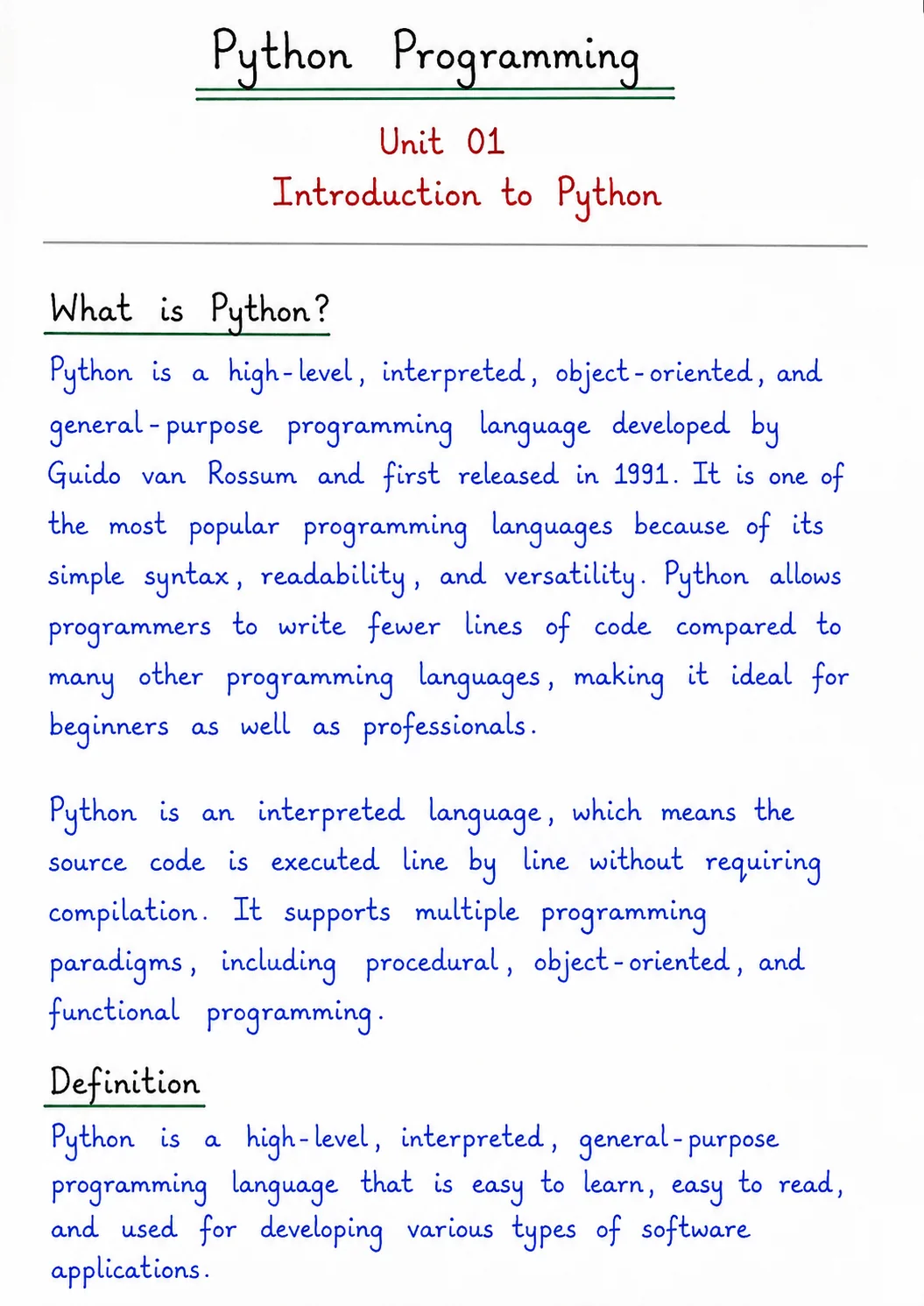
Python is a high-level, general-purpose programming language created by Guido van Rossum and first released in 1991. It was designed with a focus on code readability, using clean and simple syntax that closely resembles the English language.
Today, Python is one of the most popular programming languages in the world, used everywhere from web development and automation to data science, machine learning, and artificial intelligence.
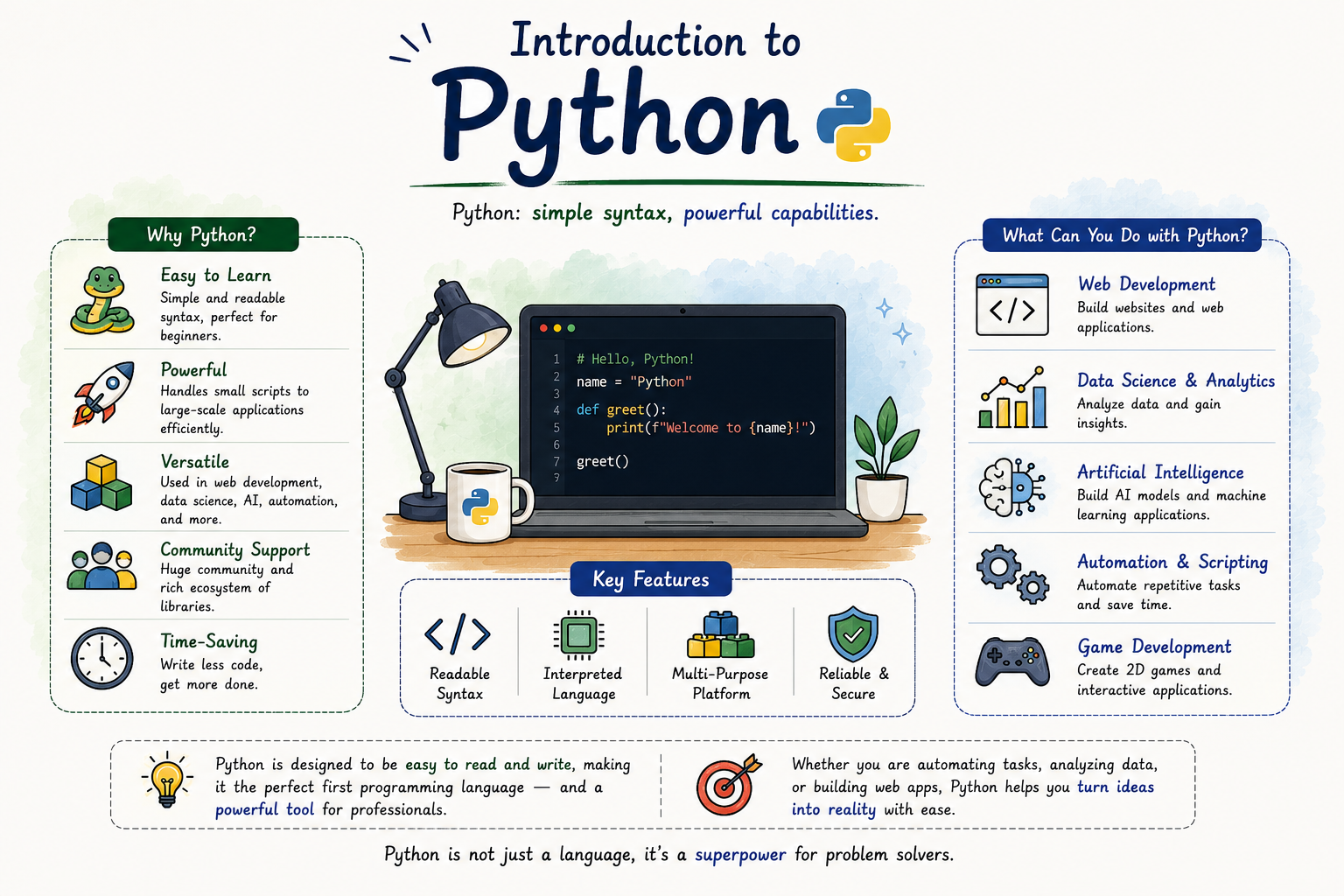
Table of Contents
History of Python
Python was conceived in the late 1980s by Guido van Rossum at Centrum Wiskunde & Informatica (CWI) in the Netherlands, and released publicly in 1991 as Python 0.9.0. The name "Python" was inspired by the British comedy series Monty Python's Flying Circus — not the snake.
| Year | Milestone |
|---|---|
| 1991 | Python 0.9.0 released publicly. |
| 2000 | Python 2.0 released, introducing list comprehensions. |
| 2008 | Python 3.0 released, a major backward-incompatible upgrade. |
| Present | Python 3.x is the standard, widely used in industry and academia. |
Features of Python
Simple & Readable
Python's syntax is close to English, making it easy to learn and understand.
Interpreted
Code is executed line by line, which makes debugging easier.
Dynamically Typed
You don't need to declare variable types explicitly.
Free and Open Source
Python is free to use, and its source code can be modified and distributed.
Portable
Python programs can run on Windows, macOS, and Linux without modification.
Extensive Libraries
A huge standard library plus third-party packages like NumPy and Pandas.
Why Learn Python?
Python is often recommended as the first programming language for beginners because of its simple syntax and gentle learning curve. It also happens to be the most in-demand language in fields like Data Science, Machine Learning, and Automation.
Fact
A "Hello World" program in Python takes just one line — compared to several lines in languages like Java or C.
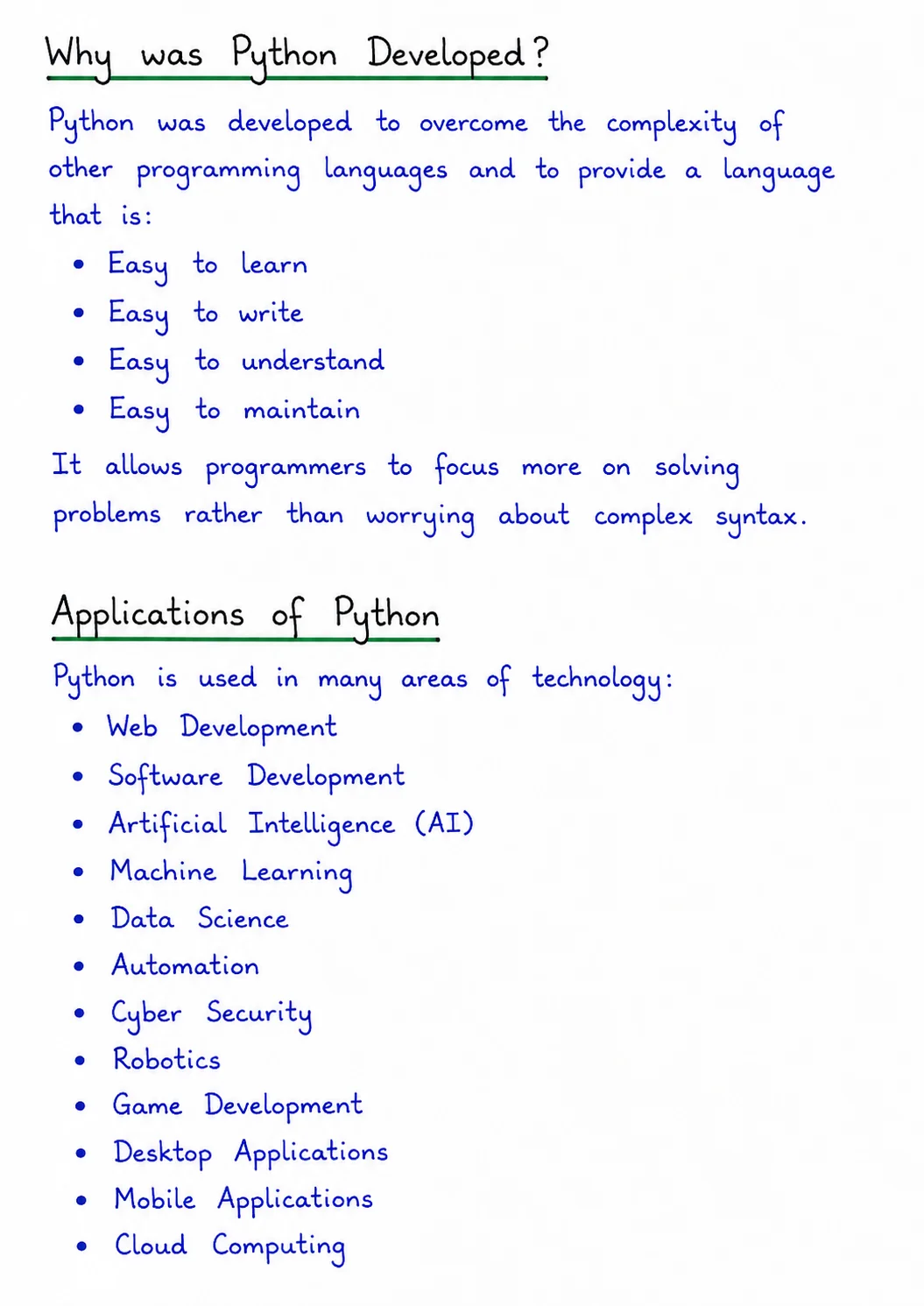
Applications of Python
Web Development
Machine Learning & AI
Data Science
Automation / Scripting
Game Development
Cybersecurity
Compiled vs Interpreted Languages
Python is an interpreted language, meaning the Python interpreter reads and executes code line by line, rather than converting the whole program into machine code beforehand.
| Compiled Language | Interpreted Language |
|---|---|
| Entire program is translated before execution. | Program is translated and executed line by line. |
| Faster execution once compiled. | Slightly slower, but easier to debug. |
| Example: C, C++ | Example: Python, JavaScript |
Code Example
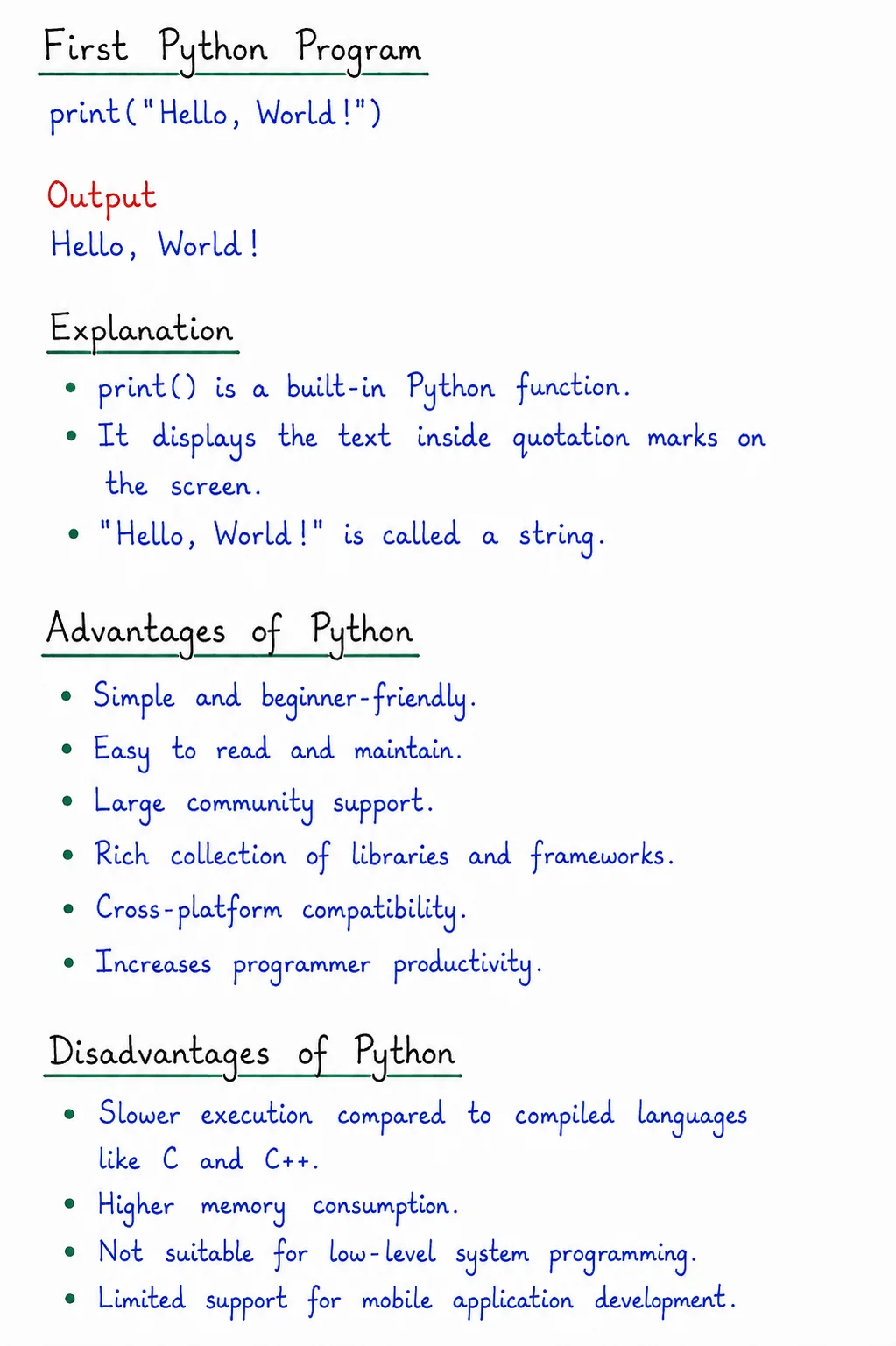
Here is what a simple "Hello, World!" program looks like in Python:
print("Hello, World!")
Output: Hello, World!
Interview Tip
Interviewers may ask "Is Python compiled or interpreted?" The precise answer: Python source code is first compiled into an intermediate bytecode, which is then interpreted by the Python Virtual Machine (PVM).
Quick Revision
| Concept | Key Point |
|---|---|
| Created by | Guido van Rossum, released in 1991. |
| Type | High-level, interpreted, dynamically typed. |
| Key Strength | Simple syntax with a huge ecosystem of libraries. |
| Popular In | AI, Data Science, Web Development, Automation. |
Summary
Python is a simple, readable, and powerful programming language created by Guido van Rossum. Its clean syntax, huge community, and rich set of libraries have made it one of the most popular languages for beginners and professionals alike — powering everything from small scripts to large-scale AI systems.