Unit 2 · Nested If and If-Elif-Else Ladder
Nested If and If-Elif-Else Ladder
Learn how to handle complex decisions with multiple choices using nested conditions and structural ladders in Python.
Learning Objectives
By the end of this lesson, you will be able to:
- Explain the need for multi-way decision-making in programming.
- Write the syntax for `nested if` statements and `if-elif-else` ladders.
- Differentiate between the use cases for nested if and if-elif-else.
- Trace the execution flow of complex conditional statements.
- Solve problems that require choosing from multiple outcomes, such as grading or categorization.
Prerequisites
To fully understand this topic, you should be comfortable with:
- Basic `if` and `if-else` statements.
- Boolean expressions and comparison operators.
Introduction
Real-world decisions are rarely simple binary (yes/no) choices. Often, we need to choose from multiple options (like giving grades A, B, C, or F based on scores) or check conditions nested within other conditions. In Python, we do this using **nested if** statements and the **if-elif-else ladder**.
Why We Need These Structures
While a simple `if-else` is great for two choices, it's not enough for more complex scenarios.
- For Multiple, Mutually Exclusive Choices: Imagine a grading system. A student can't get both an 'A' and a 'B'. We need a structure that picks exactly one grade and stops. This is where the `if-elif-else` ladder excels.
- For Dependent Conditions: Imagine checking if a user can access a secure file. First, you check if they are logged in. Only if that's true do you check if they have permission. The second check depends on the first. This is a perfect use case for a `nested if`.
Real-Life Examples
Nested If
Scenario: Applying for a loan.
if you have a good credit score:
if your income is sufficient:
Approve the loan.
The income check only happens if the credit score is good.
If-Elif-Else Ladder
Scenario: Choosing a shipping speed.
if you choose 'Express': delivery in 1 day.
elif you choose 'Standard': delivery in 3-5 days.
else: delivery in 7-10 days.
You can only pick one option.
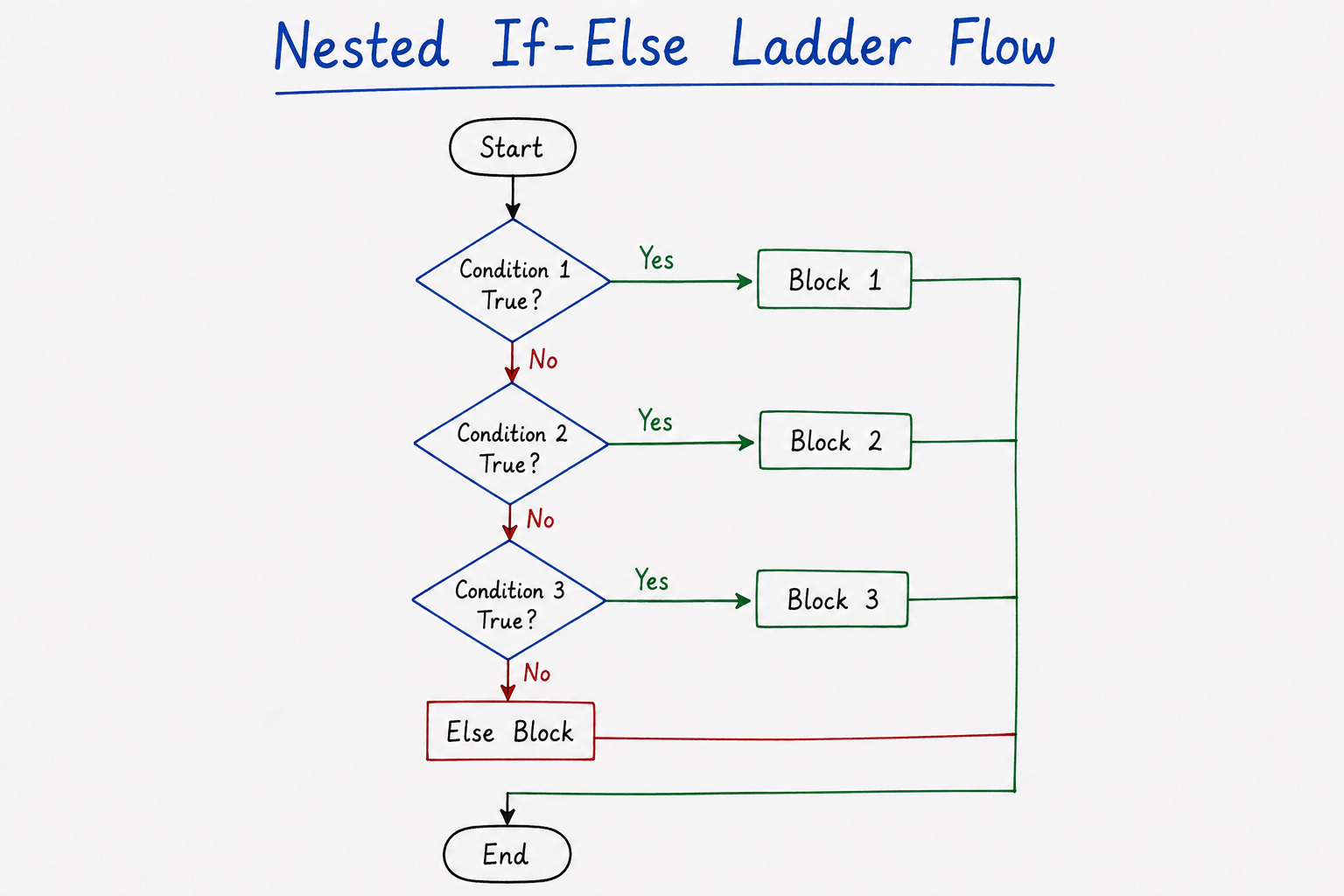
Table of Contents
Nested If Statement
An if or if-else statement placed inside another if or
if-else statement is called a nested conditional. It is used when a decision
depends on the outcome of a prior condition.
Syntax
if condition1:
    # Outer block executes if condition1 is True
    if condition2:
        # Inner block executes if BOTH condition1 and condition2 are True
        statement_block_A
    else:
        # Inner else block executes if condition1 is True but condition2 is False
        statement_block_B
Step-by-Step Explanation
- Python checks the outer condition (`condition1`).
- If it's `False`, the entire nested block is skipped.
- If it's `True`, Python enters the outer block and then checks the inner condition (`condition2`).
- If `condition2` is `True`, `statement_block_A` runs.
- If `condition2` is `False`, `statement_block_B` runs.
The If-Elif-Else Ladder
When checking multiple conditions sequentially, nesting can become deep and hard to read. Python provides
the elif keyword (short for "else if") to create clean multi-way decision trees:
Syntax
if condition1:
    block1
elif condition2:
    block2
elif condition3:
    block3
else:
    block_default
How It Evaluates (Exam Critical)
- Python checks conditions from **top to bottom**.
- As soon as the **first** condition is found to be `True`, its corresponding block executes.
- After execution, the program **skips the rest of the ladder** entirely and moves on.
- If **none** of the `if` or `elif` conditions are `True`, the final `else` block is executed as a default case.
Worked Example 1: Nested If
Checking if a number is positive and, if so, whether it's even or odd.
num = 12
if num > 0:
    print("Positive Number")
    if num % 2 == 0:
        print("It is an Even Number")
    else:
        print("It is an Odd Number")
elif num == 0:
        print("Zero")
else:
    print("Negative Number")
Worked Example 2: If-Elif-Else Ladder
Assigning a grade based on a score.
score = 85
if score >= 90:
    grade = "A"
elif score >= 80:
    grade = "B"
elif score >= 70:
    grade = "C"
else:
    grade = "F"

print("Grade is:", grade)  # Grade is: B
`if...if` vs `if...elif` (Crucial Difference)
This is a classic exam trap. Using a series of separate `if` statements is fundamentally different from using an `if-elif-else` ladder.
Series of `if` statements
Each `if` is checked independently. Multiple blocks can execute if their conditions are true.
score = 95
if score >= 80:
    print("Good score!")
if score >= 90:
    print("Excellent score!")
# Output:
# Good score!
# Excellent score!
`if-elif-else` Ladder
Only the first true block executes. The rest are skipped.
score = 95
if score >= 80:
    print("Good score!")
elif score >= 90:
    print("Excellent score!")
# Output:
# Good score!
Common Mistakes & Exam Points
Common Mistakes
- Using `if` instead of `elif`: This is the most critical error. A series of `if`s checks every condition, while `elif` checks only until one is true.
- Incorrect Indentation: A nested `if` must be indented further than its parent `if`.
- Order of `elif` conditions: Placing a more general condition (e.g., `score >= 70`) before a more specific one (e.g., `score >= 90`) will cause the specific condition to never be checked.
Exam Notes
- `elif` stands for "else if".
- An `if-elif-else` ladder guarantees that **at most one** block will execute.
- The `else` block in a ladder is optional but serves as a useful default case.
- Questions involving grading, categorization (e.g., child, teen, adult), or menus are classic `if-elif-else` problems.
Interview Questions
1. What is the main difference between using multiple `if` statements and an `if-elif-else` ladder?
Answer: With multiple `if`s, every condition is checked, and multiple blocks can potentially run. With an `if-elif-else` ladder, Python stops checking as soon as it finds the first true condition, guaranteeing that only one block executes.
2. When should you use a nested `if` instead of an `elif` ladder?
Answer: Use a nested `if` when a second condition only makes sense or is only relevant if a primary outer condition is already true. For example, checking if a file is writable only after confirming the file exists.
Practice Corner
Output Prediction Questions
# Question 1: What is the output?
day = "Sunday"
temp = 35
if temp > 30:
    print("It's a hot day.")
    if day == "Sunday":
        print("Let's go to the beach!")
# Answer:
# It's a hot day.
# Let's go to the beach!

# Question 2: What is the output?
x = 10
if x > 5:
    print("A")
elif x > 7:
    print("B")
else:
    print("C")
# Answer: A
Practice Programs
- Write a program to find the largest of three numbers using nested if.
- Write a program that takes a number from 1-7 and prints the corresponding day of the week using an if-elif-else ladder.
- Create a simple calculator that takes two numbers and an operator (+, -, *, /) and performs the calculation.
Summary
For complex decisions, Python offers two main structures. **Nested `if`** statements are used for dependent conditions, where an inner check is only performed if an outer condition is met. The **`if-elif-else` ladder** is used for multi-way branching, providing a clean way to check several mutually exclusive conditions in sequence. It evaluates from top to bottom and executes only the first block whose condition is true, making it efficient and readable for handling multiple distinct outcomes.
Python Programming Handwritten Notes
Master Python Programming with Easy Handwritten Notes – Perfect for Interviews, Placements, GATE & Exams.