Unit 2 · If-Else Statement
If-Else Statement
Learn how Python handles two-way decision-making using the if-else statement, its execution flow, and the one-line ternary form.
Introduction
A simple if statement is useful, but it has one limitation — it only tells Python what to do
when a condition is True. It does not specify what should happen when the condition is
False. In real life, almost every decision has an alternative outcome. For example:
- If it rains, carry an umbrella; otherwise, don't.
- If marks are above 40, the student passes; otherwise, the student fails.
- If the ATM PIN is correct, allow withdrawal; otherwise, deny access.
- If a number is even, print "Even"; otherwise, print "Odd".
To handle this second possibility, Python provides the if-else statement. It allows a program to choose between two alternative paths of execution — one path runs when the condition is True, and the other path runs when the condition is False.
Easy Definition
An if-else statement executes one block of code if a condition is True, and a different block of code if the condition is False.
Real-Life Example
- Traffic Signal: If light is green, go; otherwise, stop.
- Exam Result: If marks ≥ 40, pass; otherwise, fail.
- Age Check: If age ≥ 18, eligible to vote; otherwise, not eligible.
- Bank Withdrawal: If balance ≥ amount, allow; otherwise, reject.
Every situation has exactly two outcomes, and only one of them happens.
Examination Point of View
- Definition and syntax of if-else are frequently asked.
- Difference between if statement and if-else statement.
- Tracing/predicting output of if-else code snippets.
- Writing the ternary (conditional expression) form.
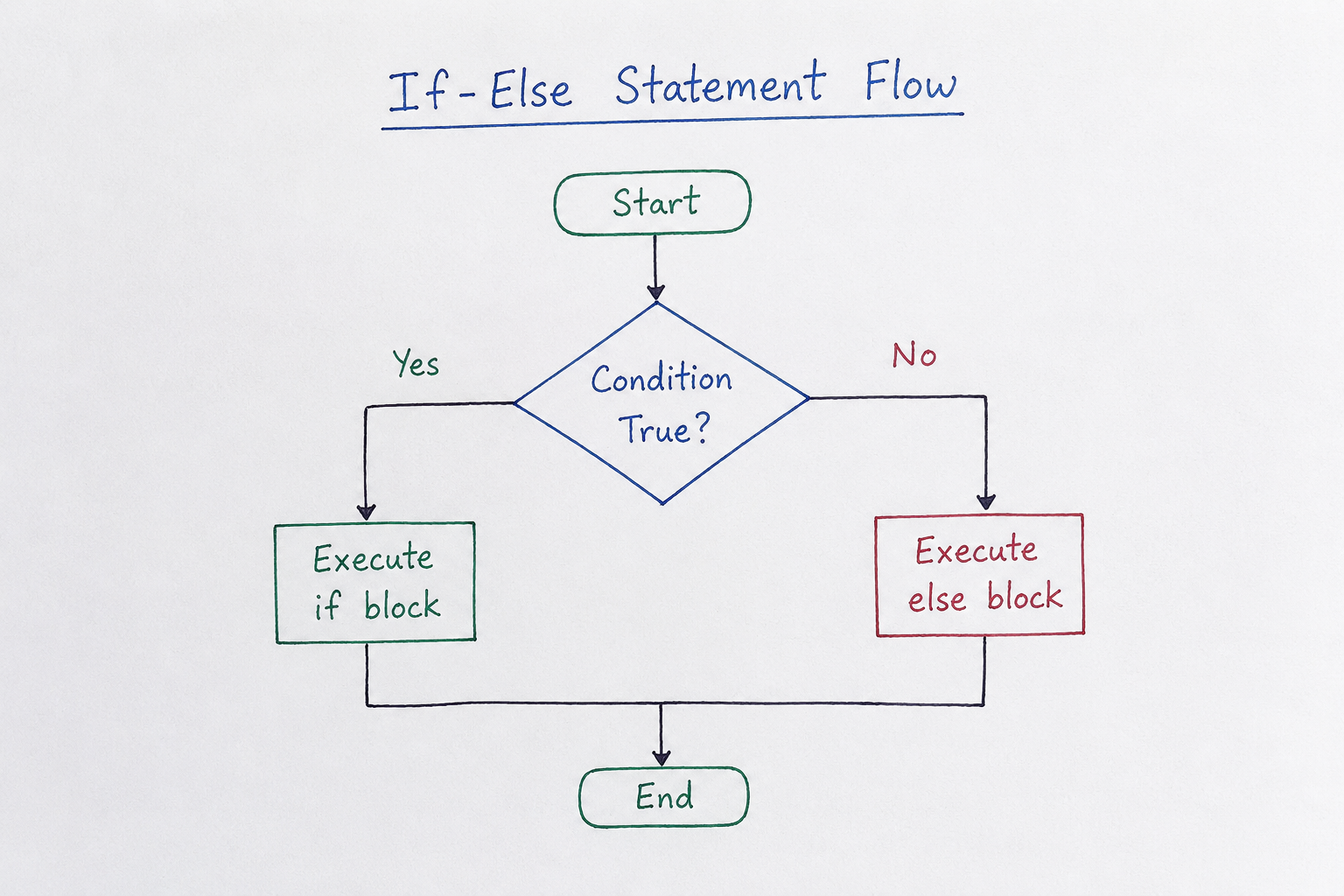
Table of Contents
Syntax of If-Else Statement
The general syntax of an if-else statement is:
if condition:
    # Executes if condition is True
    statement_block_1
else:
    # Executes if condition is False
    statement_block_2
Important Rules
- The
elsekeyword must align with theifkeyword at the same indentation level. elseis always followed by a colon (:) — never a condition.- Each block (
ifandelse) has its own indented set of statements. - An
elseblock cannot exist without a precedingif.
Warning: Writing
else condition:
is a syntax error. else never takes a condition — it simply means "in every other case."
Execution Flow
When Python encounters an if-else statement, it works as follows:
- Python evaluates the condition next to
if. - If the condition is
True, theifblock executes, and theelseblock is completely skipped. - If the condition is
False, theifblock is skipped, and theelseblock executes instead. - Execution then continues with the first statement after the entire if-else structure.
Tip
Only one of the two blocks will ever run for a single pass through the statement. They are mutually exclusive — never both, never neither.
Flow Table
| Condition Result | Block Executed | Other Block |
|---|---|---|
True |
if block | Skipped |
False |
else block | Skipped |
Code Examples
1. Even or Odd Number
num = 17
if num % 2 == 0:
    print(num, "is Even")
else:
    print(num, "is Odd")
Output
17 is Odd
2. Pass or Fail Result
marks = 35
if marks >= 40:
    print("Result: Pass")
else:
    print("Result: Fail")
Output
Result: Fail
3. ATM PIN Verification
correct_pin = 4521
entered_pin = 4521

if entered_pin == correct_pin:
    print("Access Granted")
else:
    print("Access Denied")
Output
Access Granted
Real-Life Examples
| Situation | If Block | Else Block |
|---|---|---|
| Voting Eligibility | Age ≥ 18 → Eligible | Age < 18 → Not Eligible |
| Online Shopping | Stock available → Order placed | Out of stock → Order rejected |
| Weather | Raining → Carry umbrella | Not raining → No umbrella |
If vs If-Else
| Feature | if Statement | if-else Statement |
|---|---|---|
| Number of paths | One (True case only) | Two (True and False cases) |
| When condition is False | Nothing happens; program moves on | else block runs |
| Use case | Optional/one-sided action | Two-way decision |
Ternary Operator (Conditional Expressions)
Python supports a one-line version of the if-else statement known as a
conditional expression or ternary operator. It is used to assign a value
based on a condition in a single line, without needing multiple lines of code.
result = value_if_true if condition else value_if_false
Example
age = 20
status = "Adult" if age >= 18 else "Minor"
print(status)  # Adult
Memory Trick
Read it like plain English: "Adult IF age ≥ 18 ELSE Minor." The value that comes first is the one used when the condition is True.
Exam Point
"Rewrite the following if-else statement as a single-line conditional expression" is a very common question. Practice converting multi-line if-else blocks into ternary form and back.
Common Mistakes
- Forgetting the colon (
:) afteriforelse. - Misaligning the indentation of
ifandelseblocks. - Writing a condition next to
else(not allowed). - Assuming both blocks can run together — only one ever executes.
- Confusing the order of value_if_true / value_if_false in the ternary form.
Important Examination Points
- if-else provides exactly two mutually exclusive execution paths.
- else never takes a condition of its own.
- The ternary operator is a compact, single-line equivalent of if-else.
- Tracing output of nested/if-else code is a very common exam question type.
- if-else is the foundation for the elif ladder covered in the next chapter.
Interview Questions
- What is the difference between if and if-else?
- Can an if-else statement run both blocks together? Why or why not?
- What is a ternary operator in Python?
- Write the general syntax of if-else.
- Convert a given if-else block into a one-line conditional expression.
Practice MCQs
1. What is the output?
num = 8
if num % 2 == 0:
    print("Even")
else:
    print("Odd")
Answer: Even
2. Which keyword is used to define the alternative block in an if-else statement?
A) elif B) else C) otherwise D) default
Answer: B) else
3. What is the ternary operator equivalent of:
if x > 5:
    result = "Big"
else:
    result = "Small"
Answer: result = "Big" if x > 5 else "Small"
Summary
The if-else statement chooses between two mutually exclusive executable blocks based on a
conditional test — exactly one block runs, never both. Python also provides a compact
ternary (conditional expression) form for writing simple if-else logic in a single,
readable line of code.